• Testing Lab
  • Training

Life Cycle Assessment (LCA) for Electronics

LCA Life Cycle Assessment

A Life Cycle Assessment (LCA) is a structured way to quantify a product’s environmental impacts across its life cycle—from raw material extraction and manufacturing to transportation, use, and end-of-life (recycling, disposal, or reuse). Because electronics rely on complex materials, multi-tier supply chains, and diverse end-of-life pathways, they’re often excellent candidates for LCA-driven improvement.

In plain terms: an LCA helps you see where the impacts really are so you can reduce hotspots, optimize design choices, and support credible sustainability claims with data.

What an LCA Helps you do

Companies use LCAs to:

  • identify supply chain inefficiencies, high-impact materials, and avoidable waste

  • reduce carbon footprint and other impacts by prioritizing the biggest “hotspots”

  • compare design options (materials, finishes, packaging, distribution modes, etc.)

  • support ecodesign decisions and customer questionnaires with defensible evidence

The 3 Core Phases of an LCA (LCI → LCIA → Interpretation)

Once the goal and scope are defined, LCAs typically follow three major phases:

1) Inventory analysis (LCI)

You build an inventory of inputs and outputs: materials, energy, transport, emissions, and wastes associated with the product system.

2) Impact assessment (LCIA)

You translate inventory flows into impact categories (for example: climate change, resource use, or other environmental indicators—depending on your purpose and method).

3) Interpretation

You validate results, identify hotspots, explain limitations, and turn findings into actionable improvements with measurable targets.

Life Cycle Assessment of Electronics

What you Need to Start an LCA (Practical Data Checklist)

To build an LCA efficiently, gather:

  • a bill of materials (BOM) with weights (best case: material-level details)

  • supplier and manufacturing information (locations, processes, yields/scrap if known)

  • transportation routes and modes (factory → warehouse → customer, etc.)

  • packaging composition and sources

  • use-phase assumptions (if your product consumes energy or consumables)

  • end-of-life scenario(s): recycling channels, take-back options, disposal assumptions

Even when data is incomplete, a good study can start with reasonable, transparent assumptions—then improve iteratively as better supplier data becomes available.

Principles of Life Cycle Assessments

A life cycle assessment (LCA) is an environmental management tool that organizations of all sizes can use. LCAs often assess resource use and environmental impacts of product systems. LCAs can interpret or optimize the products and methods in a manufacturing chain. The utility of LCAs is internationally recognized, and the International Organization for Standardization (ISO) has codified their standards. Enviropass uses product life cycle assessment to model and track inputs, tweak processes, and study waste and environmental emissions in product systems.


A good life cycle assessment will begin by clearly defining the purpose of the analysis. LCAs can be time-consuming and resource intensive, especially for complicated products. Well-articulated goals ensure that any subsequent research does not get overwhelmed by details. On the other hand a sharp, focused plan of action helps strengthen the credibility of any results obtained.

 
LCA Lyfe Cycle Assessment

Furthermore, analysts will set boundaries on which life cycle phases get considered. For example, exhaustive LCAs will consider each step of production across all life phases. Such a framework is known as a cradle-to-grave life cycle assessment. Your LCA may need to consider only a small subset of processes or perhaps just a specific timeframe.


The principles and execution of life cycle assessments have been standardized under ISO 14040 and ISO 14044, though compliance is not mandatory.

ISO Standards on Life Cycle Assessments

ISO has published several documents containing LCA definitions and recommendations. The standards consist mainly of two essential references: ISO 14040 and ISO 14044. The former describes the principles and framework of the LCA. On the other hand, the latter contains details and guidelines for conducting each study phase. Together with other smaller documents, the ISO 14040 family represents a comprehensive approach to LCA studies.

This set of standards has become the global benchmark for life cycle assessments. This fact is noteworthy: no two studies will be the same, and this amount of variability can be daunting. Fortunately, the ISO 14040 system provides a clear and comprehensive approach to LCAs. The framework is designed for use in many situations across different industries. The result is an opportunity to apply the system to a number of considerations or problems.

Enviropass Expertise Solution

Life Cycle Assessments: Scope and Length

Of course, creating a piece of modern consumer electronics can involve countless processes. Consider a simple wristwatch: the watchmaker must first buy raw materials extracted from around the globe. These inputs must then be processed, transported, and reprocessed several times.

Eventually, the customer may throw the watch away, and it will join the millions of tons of e-waste landfilled annually. In this case, the LCA may target any quantifiable improvements per wristwatch. This type of focus quantifies the wristwatch as the functional unit of the LCA. This term refers to the smallest indivisible unit considered in the study.

Transportation of Goods LCA

Life Cycle Stages

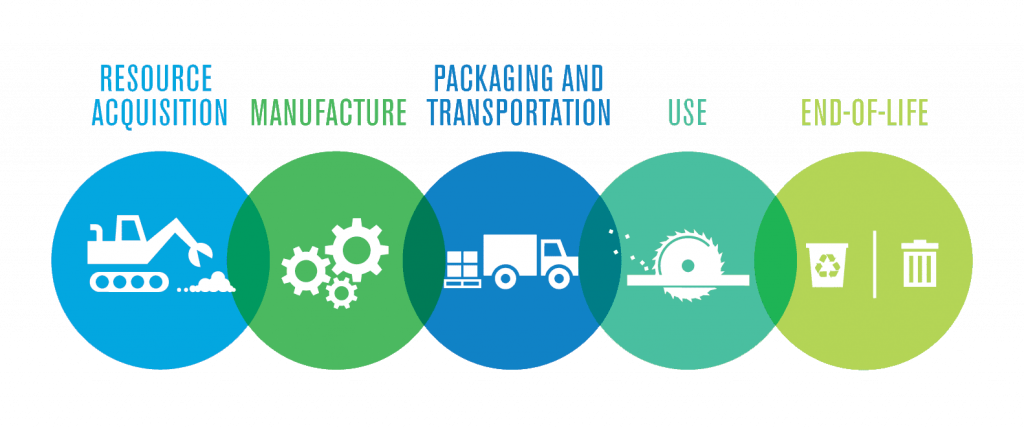
Modern analysts categorize a life cycle into broad phases or timeframes. While the phase boundaries can vary between auditors, each undoubtedly offers an opportunity for critique – and often, improvement.

Resources are raw materials that come from natural deposits around the globe. Extraction techniques include digging, blasting, pumping, etc. Sometimes, post-extraction processes like smelting or filtering get included here.

The Manufacturing phase considers the processes required to create the final product from raw materials. Intermediate processes also fall into this category, along with many waste by-products.

The Transportation phase (otherwise known as distribution) occurs when the product is ready to leave the factory or the office. Packing and shipping processes occur here according to their energy and resource demands. Other metrics considered at this stage include marketing impact and the carbon footprint of transporting goods.

End-of-life Product

Active Use refers to the time starting when a customer buys or begins using the product. Clearly, the bulk of this phase belongs to the new product owner while they enjoy their purchase. Maintenance and aftermarket repair services belong in this phase, regardless of who performs them.  

Finally, every physical good has an End-of-Life. Whether it gets recycled, scrapped, or thrown in a landfill, this phase considers the steps involved in transporting a product to its final resting place. Secondary services like elemental recovery or municipal drop-off sites are also detailed here.

Life Cycle Assessment Phases

To summarize, a life cycle assessment begins with a period dedicated to laying crucial groundwork. A well-bounded scope, together with a thoughtful and detailed plan of action, will define the structure and approach of the analysis. Once data collection begins, experts conducting an LCA usually follow three main steps.

The first step is the Inventory Analysis. Chiefly, it is an enumeration of all inputs used for creating a product. Depending on the LCA’s timeframe, we may consider any period from raw materials to end-of-life. Each phase gets assessed according to any processes that require energy or resources.

The second phase is the Impact Assessment. Completing the inventory will likely result in a list of processes associated with the product and relevant timeframe. This next step helps categorize the list and allows us to quantify any process outputs, including unwanted by-products.

Usually, categories are specific enough so that the analysis maintains direction and relevance. However, they must also be open-ended enough so that we can include every process. Therefore, performing the impact analysis is a particularly delicate exercise. Strong execution of this critical step requires foresight and creativity.

Finally, the Interpretation Phase lays out measurable, attainable goals for mitigating environmental impact. The LCA may uncover areas of production that require special attention; outdated exhaust treatment systems and transportation redundancies are some examples. Consequently, the improvement analysis should result in a straightforward plan for tackling these issues. Improvements should be quantifiable and expressed via the LCA’s functional unit.

Applications of LCAs

As mentioned, LCAs have broad utility and can address many different classes of projects. Life cycle assessments are particularly well-suited to product life cycles due to the model’s relative and iterative nature. This approach emphasizes the importance of perspective with respect to the study goals and expectations. Missing data, incomplete sources, or insufficient evidence are handled by revisiting earlier phases of the study and refining the structure and methods.

LCAs can also be flexible with respect to time. Different stages of the product’s life cycle become included or omitted as the circumstances demand. This option allows us to capture projects of widely varying scope. Examples can be small and simple (e.g., a single product stage) or intricate and detailed (e.g., an entire fabrication plan).

Life Cycle Assessement Make this World Better

Some popular applications of LCAs include:

  • Identifying opportunities for saving time, effort, or resources
  • Identifying opportunities for reducing or eliminating environmental emissions, scrap, or waste
  • Creating or expanding reuse, refurbishment, or recycling streams
  • Optimizing water, energy, or fuel use
  • Distribution and supply chain auditing

Indeed, there are few hard limits when using a life cycle assessment. Clearly, certain instances do exist where an LCA is not the most appropriate tool. Examples include economic or social questions with no connection to related environmental considerations. However, LCAs are always a potential option when the main issues have clear and tangible impacts on nature and human health. Their potential for modelling vastly different scenarios make them strong candidates for analyzing even very complex systems.

Why is LCA important?

LCAs have become popular tools for optimizing product ecodesign. Identifying the costs, inputs, and losses associated with a product provides deeper insight into the methods used for bringing it to market. However, collecting and organizing the sheer amount of information can be overwhelming.

Therefore, a well-designed LCA allows us to classify, analyze, and deconstruct the steps in a production process. Quality assessments using modern methods are easy to maintain. Experts construct them layer-by-layer to provide a range of perspectives according to their needs.

How do you conduct a Life Cycle Assessment?

Clearly, the more you know about your product, the better your model becomes. A product bill of materials (BOM) is a great starting point. Other valuable considerations include supply chain, environmental regulation, transportation, and warehousing information.

LCA databases include many variations on factors that can help fine-tune your analysis. For example, valuable metals (like iron) used in industry exist in many states. A company may buy high-quality ingots for casting its flagship product. During production, machining operations may generate waste filings or shavings.

In an LCA, the ingots and the waste would occupy separate categories. Though the two materials have the same chemical composition, they have different flows and costs associated with their processes. Therefore, they must occupy different roles within the analysis.

Environmental Audit
LCA of devices

What do I Need to Create an LCA?

If you feel you might need to assess a product or service that your company provides, start by gathering as much information as you can:

  • What sort of information does the BOM contain? Does each of your components have traceable supply chains?
  • Where do you source your materials or intermediate products? What steps are needed to get them to your door?
  • What are the different shipping channels you use to manage flows? Do you have the same depth of information for each channel?
  • Do you have a final product that requires packaging? Can you trace the sources of your package materials?
  • Do your packaging and production processes occur in the same plant? Is there extra shipping involved?
  • Does your product have an end-of-life plan, like recycling alliances or designated disposal sites? Which channels exist for your product to be repurposed, recycled, or recovered?
  • Do you wish to consider standards compliance under the ISO 14040 family?

Typically, this information feeds into a specialized LCA software suite. Such platforms are readily available, and LCA experts use them to create custom analyses for studying products and optimizing processes.

How Enviropass Expertise Inc. approaches product LCAs

Our approach is designed to make LCAs practical for real-world product decisions:

  • We use your supply chain, fabrication, transportation, and end-of-life data to map a product system.

  • We complement it with internationally recognized databases and LCA software to quantify impacts across stages.

  • We translate results into manageable improvement actions (materials, logistics, manufacturing efficiency, waste reduction, etc.).

Sustainability Digital Product Passport

Life Cycle Assessment - LCA - FAQ

What is an LCA in one sentence?

A method to measure environmental impacts across a product’s life—from raw materials to end-of-life.

When you need to compare design options, reduce hotspots, respond to customer sustainability requirements, or build a credible data baseline for product improvement.

  • Cradle-to-gate: impacts from raw material extraction up to the product leaving the factory (or your defined “gate”).

  • Cradle-to-grave: includes cradle-to-gate plus distribution, use phase, and end-of-life.

Common inputs include bill of materials (materials and weights), manufacturing processes and energy use, scrap rates, packaging, transportation routes/modes, product lifetime and use assumptions (if applicable), and end-of-life scenario assumptions (recycling rates, landfill, incineration).

LCAs are typically based on ISO principles (ISO 14040/14044). Credibility comes from clear system boundaries, transparent assumptions, consistent allocation rules, quality data sources, and, when the study will be published or used for a claim, an independent critical review.

No, but these standards are globally recognized benchmarks for how LCAs should be structured and reported.

If you’re ready to create your own product LCA, visit our LCA Tool and let our experts help you get started!

Are you having technical issues with the form, or do you have other concerns? Contact Enviropass today for a free consultation to discuss your needs and answer your questions.