

From the smartphones you use on a daily basis to the waterproof jacket you wear on a rainy day, per- and poly-fluoroalkyl substances (PFAS) are present in many everyday electronics. However, these substances pose significant health and environmental risks, and their usage is being restricted by environmental regulations. Thus, learn about the risks associated with these hazardous substances in electronics and discover practical ways to reduce your exposure.
There are currently obligations to declare certain pfas in jurisdictions like the EU, Canada and the USA, under TSCA-PFAS.
Restrictions also apply in the EU, Canada, and certain US states.
Need to know which PFAS regulations apply to your product? Contact Enviropass for a free consultation.
Need to know which PFAS regulations apply to your product? Contact Enviropass for a free consultation.
The definition differs from a jurisdiction to another. However, PFAS cover thousands of molecules with common characteristics. Here are the main definitions.
According to the Organization for Economic Co-operation and Development (OECD), with a few exceptions, PFAS are molecules containing at least one fully fluorinated methyl (CF3) or methylene (CF2) group without any hydrogen or halogen atom directly bonded.
The European Chemicals Agency (ECHA) suggests that PFAS are molecules containing at minimum one fully fluorinated methyl (CF3) or methylene (CF2) carbon atom without any hydrogen or other halogens (e.g., chlorine, bromine, iodine) directly bonded to it.
Moreover, the U.S Environmental Protection Agency (EPA) states that PFAS are molecules containing fully saturated carbon atoms containing the R-CF2-CFR’R’’ unit. Here, R, R’, R’’ groups refer to any alkyl group besides hydrogen atoms.

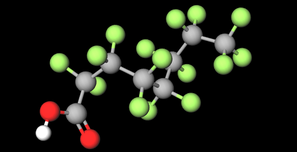
Here is an example of a PFAS Structure where R can be any alkyl group besides halogens or hydrogen atoms:
R-(CF2)-CF3
Thousands of PFAS exist. However, there are two main types of PFAS:

This type of PFAS is made up of a long chain structure with repeating units of fluorinated organic molecules. Typically, they are in applications requiring high chemical and thermal stability. Thus, these PFAS, like PTFE, are commonly present in articles i.e., physical products.
By contrast, this type of PFAS consists of short-chain molecules. Additionally, they contain fewer repeating units of fluorinated organic molecules. Frequently, this type is for applications requiring lower viscosity and better solubility. Therefore, they are usually present in chemical mixtures.
Likewise, common PFAS’ in electrical and electronic products include:
Importantly, we can even find PFAS in metal plating applications!
These substances have a variety of purposes that serve the electronic industry. Indeed, their main properties include:
PFAS molecules | Applications |
|---|---|
Perfluorooctanoic acid (PFOA) |
|
Perfluorooctane sulfonic acid (PFOS) |
|
Polytetrafluoroethylene (PTFE) |
|
Perfluorobutane sulfonic acid (PFBS) |
|
Properties | Description |
|---|---|
Chemical Stability | PFAS are highly resistant to chemical reactions and degradations. This increases their stability over time. |
Thermal Stability | They can withstand high temperatures without degrading or releasing toxic-by products. |
Low surface tension | They are highly repellant to liquids. They help to create non-stick surfaces. |
High thermal and electrical insulation | They are useful in electrical components and thermal insulation applications. |
Hydrophobicity | They are highly water-repellent. This makes them useful for water-resistant coating or even firefighting foams. |
Lubricity | They are highly lubricious making them useful as release agents or lubricants. |

The problem with PFAS is their persistence in the environment and bioaccumulation in the human body. In fact, carbon-fluorine bonds are among the strongest and do not break down easily, leading to long-term exposure risks. They are often referred to as “Forever Chemicals” for this very reason.
Namely, they have been linked to a variety of health problems including:
Moreover, PFAS are persistent in the environment. Therefore, they can contaminate:
In fact, they can accumulate in food chains reaching high trophic levels such as predatory birds and marine mammals!
Common applications of PFAS in electronics include:
Application | Description |
|---|---|
Semiconductors | They are used as process aids in the manufacturing of semiconductors. |
Printed Circuit Board Assemblies (PCBA) | They are used as soldering agents. |
Printed Circuit Board (PCB) Laminates | They are used as flame-retardants to reduce the risk of fire. |
Cable polyvinylidene fluoride (PVDF) coatings | They prevent electrical arcing. They leave PFOA residues and impurities. |
Computer Hard Drives | They are used as lubricants to reduce friction between moving parts. |
Synthetic Rubbers and fluoroelastomers | PTFE is used as a processing aid to produce fluoroelastomers. They can remain as a residue in the final product. |
Polycarbonates | PFAS can be used as an additive. For example, PFBS is used for this purpose. |
PTFE tapes | Leaves unintentional residues of PFOA. PTFE is often used as a coating on tapes. |
Mineral oil (grease) | They can contain PFAS as impurities. |
PFAS requirements appeared in 6.4% of the Enviropass projects analyzed between January and August 2026.
Our PFAS work most often involved laboratory testing or product/BOM assessments, frequently alongside RoHS, REACH, Proposition 65, TSCA-PBT and POPs. Common evidence gaps included missing or unclear manufacturer compliance statements, missing test reports, and reports covering only a limited PFAS subset such as PFOA.
This illustrates why PFAS compliance often requires more than a generic “PFAS-free” declaration: the applicable jurisdiction, PFAS definition, substance scope and available supply-chain evidence all need to be considered.
See the full 2026 Product Environmental Compliance analysis.
Source: Enviropass Expertise Inc., 2026 Product Compliance Project Portfolio, January–August 2026.
Considering growing concerns surrounding PFAS, many jurisdictions have started to regulate their use in electronics.

There are two types of control:
They only apply to PFAS intentionally added i.e., not present as impurities. For instance, they are subject to the following reporting requirements:
Long-chain PFAS (particularly PFOA) are restricted due to their persistence and toxicity concerns.
In the EU and Switzerland, the following apply:
Regulations | Description |
|---|---|
Restriction of common PFAS (PFOA, PFOS) in certain applications. | |
EU REACH Annex XVII, entry 65 |
Heptacosafluorotetradecanoic acid (PFTDA); including its salts and precursors |
EU REACH SVHCs | Several Substances of Very High Concern (SVHCs) are PFAS, like Ammonium pentadecafluorooctanoate (APFO). SVHCs must be communicated abode a threshold of 0.1%, component level. |
Region | Regulation | Description |
|---|---|---|
United States of America | Toxic Substances Control Act (TSCA) | |
US States | PFAS labelling, reporting, or bans | Some of these restrictions apply to electronic products. |
Canada | Canadian Environmental Protection Act (CEPA) Long-chain (LC) PFAS Restriction | A proposed restriction on the manufacture, use, and release of LC-PFAS into the environment. |
Region | Regulation | Description |
|---|---|---|
Japan | Chemical Substance Control Law (CSCL) | The Japanese government has the authority to restrict or ban the use of chemical substances, including PFAS, and to require companies to adopt measures to reduce releases to the environment and minimize exposure to these substances. |
Australia | Industrial Chemicals Introduction Scheme (ICIS) | ICIS provides a framework for the assessment of PFAS used in industrial and consumer products, and for the management of their risks. |
One of the solutions to reducing PFAS in electronics lies in finding alternatives that are safer for both the environment and human health. Where is a PFAS used? For what usage? Some possible alternatives include:
Silicones are non-toxic and do not persist in the environment. They are also resistant to heat and water, making them a suitable alternative to PFAS in electronic products. However, silicones don’t restist to oil as much as PFAS.
Furthermore. natural oils and waxes, such as beeswax and vegetable oil, can be used as an alternative to PFAS in electronic products that require grease resistance. These natural products are biodegradable and do not pose a threat to human health or the environment.
In addition, bio-based polymers are made from renewable resources, such as corn starch or sugarcane, and are biodegradable. They can be an alternative to PFAS in electrical insulation and other applications in electronics.


Subsequently, fluorine-free coatings, such as polyethylene, can be used as an alternative to PFAS in electronic products that require stain and grease resistance. These coatings are biodegradable and do not pose a threat to human health or the environment.
Also, glass-reinforced composites can be an alternative to PFAS in electronic products that require strength and durability, such as circuit boards. Glass-reinforced composites can provide similar mechanical properties as PFAS and are more environmentally friendly as they do not contain PFAS. In addition, glass-reinforced composites can be easily molded and shaped, making them suitable for use in a variety of electronic products.
Finally, bio-based materials such as bioplastics are another alternative to PFAS in electronics. They are derived from renewable resources and do not contain PFAS. These materials can be used to manufacture electronic components, such as casings and cables, and can provide similar performance to PFAS-based materials. Using bio-based materials in electronics can also help reduce the industry’s carbon footprint, as they are produced from sustainable sources and do not contribute to the depletion of non-renewable resources.
PFAS are used because they provide critical performance benefits, including:
These properties make them difficult to replace in high-performance electronics.
PFAS can be found across many components and materials, including:
They are also used in manufacturing processes such as photolithography and cleaning.
Yes, PFAS are increasingly regulated worldwide, including:
Regulations are evolving rapidly, with potential broad PFAS bans under discussion.
Common PFAS used in electronics include:
Identifying PFAS requires a combination of:
Supply chain transparency is critical due to hidden PFAS in components and processes.
Do you need to verify PFAS in electronics? Request free consultation with Enviropass!
Written and technically reviewed by: Aurélien “Aury” Hathout, M.Env., VEA®, CEA
Last technical review: September 2026
This page was reviewed for technical accuracy using primary and authoritative regulatory sources from the United States, European Union and Canada.
This page is based primarily on official government and regulatory sources, including: