
Environmental regulations are evolving faster than ever. New substance restrictions, reporting obligations, product design rules, packaging requirements, extended producer responsibility programs, and environmental management expectations are emerging across Canada, the United States, the European Union, and many other markets. For manufacturers, importers, distributors, and brand owners, staying compliant is no longer a one-time exercise. It requires structured, documented, and ongoing regulatory monitoring.
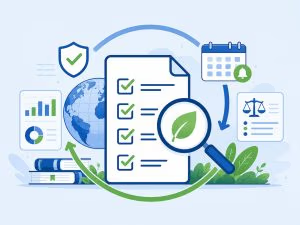
At Enviropass, regulatory monitoring is one of our core environmental compliance services. Our team helps companies identify, understand, track, and manage the environmental laws, regulations, standards, and customer requirements that apply to their products, activities, services, and target markets. Enviropass already highlights regulatory monitoring as part of its environmental compliance and ISO 14001 support services, including environmental compliance auditing, product assessment, and environmental management system implementation.
Regulatory monitoring, sometimes called legal monitoring, compliance monitoring, or regulatory watch, is the systematic process of identifying and following applicable legal and other requirements. It allows an organization to answer essential questions such as:
In most countries, including Canada and the USA, State and local laws control activities interacting with the environment.
For manufacturers, regulatory monitoring may cover substance restrictions and other environmental or social compliance frameworks. Enviropass provides environmental compliance consulting for many of these areas, including substance control, training, management systems, life cycle topics, and social compliance.
A company can only comply with the requirements it has identified. Without regulatory monitoring, environmental compliance becomes reactive. The organization may discover a new obligation only after a customer request, a failed audit, a customs issue, a blocked product launch, or a market surveillance inquiry.
By contrast, a structured regulatory monitoring process helps companies anticipate change. It supports better planning, supplier communication, product design, documentation updates, testing strategies, and risk management. It also helps avoid unnecessary lab testing by clarifying when a documentary approach, supplier declaration, material disclosure, or technical justification may be sufficient.
For companies selling products internationally, regulatory monitoring is especially important because requirements differ by market. A product that is acceptable in one country may trigger reporting, labeling, restriction, or documentation obligations in another. This is particularly true for electrical and electronic equipment, furniture, medical devices, toys, chemicals, batteries, packaging, aerospace components, automotive products, and industrial equipment.
Regulatory monitoring is directly connected to ISO 14001, the international standard for environmental management systems. ISO 14001 requires organizations to determine their compliance obligations, understand how they apply, take them into account when establishing the environmental management system, and evaluate compliance over time.
In practical terms, this means an ISO 14001-certified or certification-ready organization must do more than simply list laws in a register. It must understand which requirements apply, why they apply, who is responsible, what actions are needed, what evidence is maintained, and how compliance is evaluated. Enviropass specifically connects regulatory monitoring to ISO 14001 compliance obligations and environmental compliance evaluation, including ISO 14001 clauses 6.1.3 and 9.1.2.
Regulatory monitoring supports several key parts of ISO 14001, including:
Identifying external environmental issues, stakeholder expectations, market requirements, and regulatory trends.
Determining compliance obligations, environmental risks, opportunities, objectives, and action plans.
Ensuring that activities, products, services, suppliers, contractors, and outsourced processes are managed according to applicable requirements.
Checking whether compliance obligations are fulfilled through audits, document reviews, inspections, and compliance evaluations.
Correcting nonconformities, updating procedures, and strengthening the environmental management system.
This is also becoming increasingly important with the transition toward ISO 14001:2026, which is expected to strengthen attention to climate change, biodiversity, life cycle thinking, value chain impacts, external providers, and change management. Enviropass has already published guidance on ISO 14001:2026 and how organizations can prepare without rebuilding their entire EMS from scratch.
Enviropass offers regulatory monitoring in a practical, business-oriented way. Our goal is not to overwhelm your team with legal language. Instead, we translate environmental obligations into clear, actionable compliance requirements.
Our regulatory monitoring service can include:
We determine which environmental laws, regulations, standards, directives, customer requirements, and market-entry obligations may apply to your products, activities, services, and target jurisdictions.
We help build a structured compliance obligations register that can be used for ISO 14001, internal audits, customer audits, supplier management, and management reviews.
Not every regulation applies the same way. Enviropass helps determine whether a requirement is applicable, partially applicable, not applicable, or applicable only under specific conditions.
We summarize what the requirement means in practice: documentation, testing, declarations, labeling, reporting, supplier communication, recordkeeping, deadlines, or market restrictions.
We help your team stay aware of upcoming changes, new obligations, substance list updates, restriction proposals, enforcement trends, and transition periods. We also provide environmental audits on demand.
When a gap is identified, Enviropass can help create a corrective action plan, identify missing evidence, contact suppliers, review documentation, or recommend targeted testing.
We align regulatory monitoring with your EMS processes, including compliance obligations, environmental aspects, risks and opportunities, operational controls, internal audits, and management review.
For products, Enviropass can connect regulatory monitoring with documentary reviews, supplier declarations, technical files, certificates of conformity, lab testing strategies, and supply chain risk assessments.
Product environmental compliance is a moving target. Restricted substance lists change. Exemptions expire. PFAS requirements expand. Packaging and battery regulations evolve. Reporting schemes become more demanding. Customers request more transparency. Authorities expect better evidence.
Enviropass helps companies monitor these developments and connect them to real products and materials. For example, a regulatory update may trigger a review of your Bill of Materials, supplier declarations, test reports, certificates, packaging data, or technical documentation. This approach helps transform regulatory monitoring from a passive news-tracking activity into a reliable compliance management tool.
This is particularly useful for companies that need to demonstrate due diligence for RoHS, REACH, PFAS, POPs, TSCA, California Proposition 65, Canadian requirements, EU market access, environmental claims, packaging obligations, and other product environmental compliance programs.
Enviropass is an environmental compliance consulting firm based in Montreal, Quebec, Canada, serving companies with products sold in North America, Europe, and worldwide. Our team supports manufacturers, importers, and organizations across sectors such as electrical and electronic equipment, aerospace, automotive, furniture, medical devices, chemicals, metal parts, military products, and toys.
Our approach combines regulatory knowledge, technical product understanding, environmental auditing experience, and ISO 14001 expertise. We can help you create a regulatory monitoring process that is not only informative but also auditable, practical, and useful for decision-making.
Enviropass can also support EMS-related services, including:
For companies preparing for ISO 14001 certification, maintaining an existing EMS, launching products in new markets, or responding to customer compliance requests, regulatory monitoring is a smart foundation.
Regulatory change can feel complex, but it can also become a competitive advantage. Companies that monitor requirements early can design better products, avoid last-minute compliance issues, answer customer questions faster, reduce audit stress, and demonstrate stronger environmental responsibility.
With Enviropass, regulatory monitoring becomes more than a list of regulations. It becomes a structured compliance system connected to your products, suppliers, environmental management system, and business goals.
Regulatory monitoring is the ongoing process of identifying, tracking, and reviewing environmental laws, standards, and other compliance obligations that may apply to an organization’s products, activities, services, or markets. It helps companies stay informed before requirements become urgent compliance issues.
ISO 14001 requires organizations to determine their compliance obligations, understand how they apply, and evaluate whether they are being fulfilled. Regulatory monitoring supports this process by keeping the organization’s legal register and compliance obligations up to date, which strengthens environmental management system planning, audits, and management reviews.
Enviropass can help monitor product environmental compliance and environmental management requirements such as RoHS, REACH SVHC, REACH Annex XVII, PFAS, POPs, TSCA-PBT, California Proposition 65, WEEE, packaging, batteries, ecodesign, energy efficiency, conflict minerals, and other applicable environmental or social compliance obligations.
Yes. Enviropass can help create or update a legal and regulatory register tailored to your organization, products, activities, and markets. This register can include applicability status, compliance actions, responsible persons, deadlines, evidence required, and links to ISO 14001 compliance evaluation activities.
No. Regulatory monitoring is useful for any organization that wants to manage environmental compliance proactively. It is especially valuable for companies selling products in multiple jurisdictions, responding to customer compliance requests, preparing for audits, launching new products, or building an environmental management system.
The frequency depends on your activities, products, markets, and risk level. Many organizations review regulatory updates yearly or quarterly, while high-risk sectors or companies selling internationally may need more frequent monitoring. Enviropass can help define a practical monitoring schedule based on your compliance needs.
Need help identifying your environmental compliance obligations? Contact Enviropass to build or strengthen your regulatory monitoring process and connect it to ISO 14001.