By Sheena P Ramdin | Reviewed by Aurélien Hathout, M.Env., VEA®, CEA | Last updated: November 7th, 2026
In short: IPC-1754 is an industry standard, published by IPC in 2018 with the support of the International Aerospace Environmental Group (IAEG), that defines a common XML format for exchanging materials and substances data between suppliers and customers. It offers three levels of declaration: Class E (answers to a query list), Class F (substances from a declarable substance list) and Class G (all substances in a product or process). IPC-1754 is not a regulation, but aerospace and defense customers often require it from their suppliers to manage EU REACH and other chemical regulations.
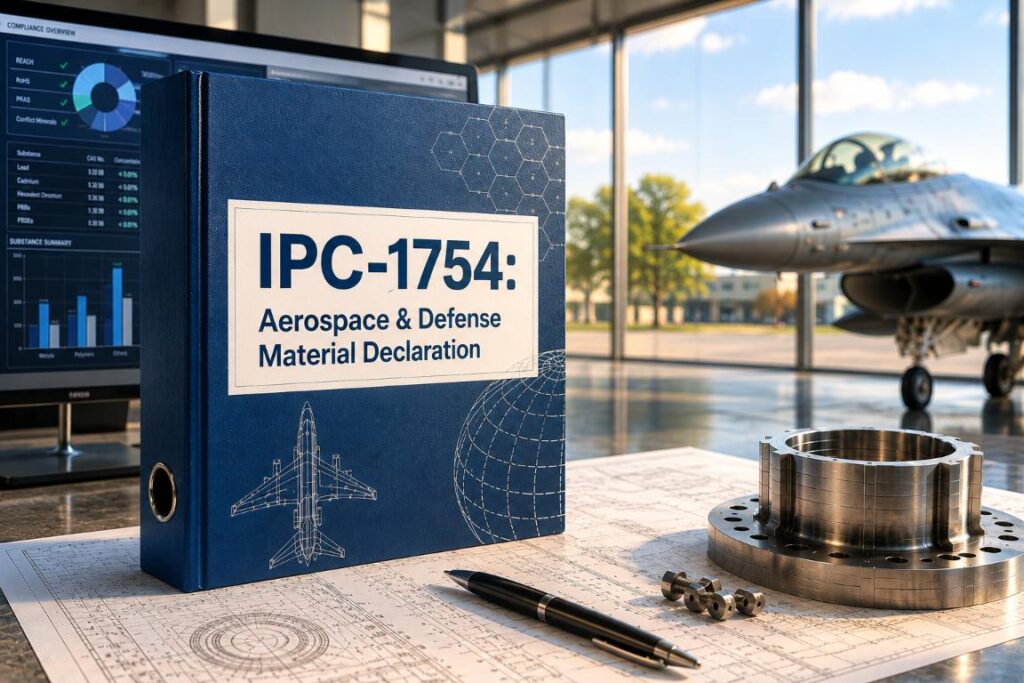
IPC-1754, “Materials and Substances Declaration for Aerospace and Defense and Other Industries,” standardizes how suppliers report the materials and substances in their products. It was developed primarily for the aerospace and defense industry, but any industry can use it.
Instead of filling in a different spreadsheet for every customer, suppliers provide one declaration in a standard XML format that compliance software can read automatically. This makes data easier to exchange, combine and check along long, multi-tier supply chains.
IPC-1754 was built on the structure of IPC-1752A, the standard used in electronics. However, it was designed for complex products with deep supply chains, and primarily structured to support the EU REACH Regulation. The standard was first published in 2018, followed by Amendment 1 in 2019 and Amendment 2 in 2020. Amendment 2 added optional fields to support the EU SCIP database.
IPC-1754 declarations are typically requested by:
If you supply parts, materials or chemicals into these supply chains, you can expect to receive IPC-1754 requests.
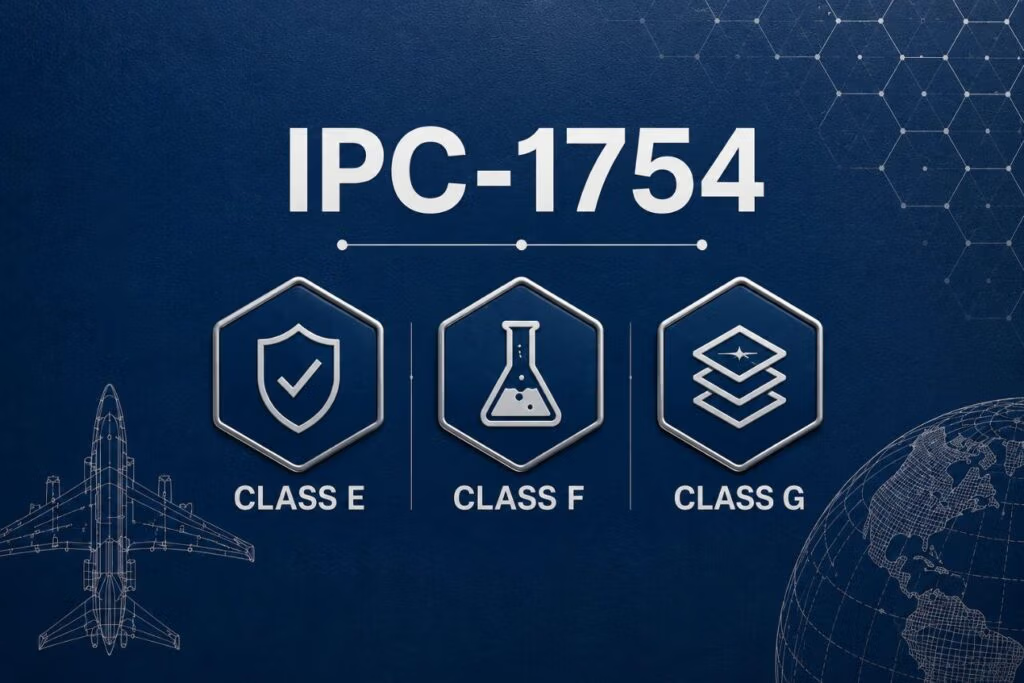
The requester chooses the level of detail it needs. IPC-1754 defines three declaration classes:
Class | What the supplier provides | Level of detail | Typical use |
|---|---|---|---|
Class E | Answers (true, false or unknown) to a query list, for example: "Does the product contain a REACH SVHC above 0.1%?" | Low | Quick compliance screening |
Class F | Each substance from the requested declarable substance list (DSL) that is present above its threshold, with its mass or mass percent | Medium | REACH SVHCs, restricted substances, customer-specific lists |
Class G | All substances in the product and/or in the manufacturing process, ideally organized by material and article | High | Full material disclosure, obsolescence management, preparing for future regulations |
A declarable substance list (DSL) is the set of substances the requester wants reported, identified by name and version. It can be based on a regulation, such as the REACH Candidate List, on an industry list, such as the IAEG Aerospace and Defence Declarable Substances List (AD-DSL), or on a company’s own list.
Regulation | How IPC-1754 helps |
|---|---|
EU REACH SVHCs (Article 33) | Reports SVHCs with their mass percent in the declarable article, to check the 0.1% threshold |
EU SCIP database | Amendment 2 adds optional fields for the information required in SCIP notifications |
REACH authorisation and restrictions | Process-substance declarations reveal chemicals at risk of obsolescence; restricted substances can be requested through the DSL |
Restricted substances and exemptions can be declared, although IPC-1752A remains the usual format for electronic components | |
Substances of interest can be requested by including them in the DSL | |
Listed chemicals can be requested by including them in the DSL |
These three material declaration standards are often confused. Here is how they compare:
| IPC-1752A | IPC-1754 | IEC 62474 |
|---|---|---|---|
Main industry | Electronics | Aerospace, defense and heavy equipment | Electrotechnical industry |
Published by | IPC | IPC, with IAEG support | IEC (international standard) |
Declaration levels | Class A, C and D (up to full material declaration) | Class E, F and G (up to full substance declaration) | Declarable substances, with optional full material declaration |
Substances used in processes | No | Yes | No |
Main regulatory focus | Built for EU RoHS, extended to REACH | Built mainly for EU REACH | Broad, through its own declarable substance list |
Substance list | Defined by the requester | Any DSL by version, such as the IAEG AD-DSL | IEC 62474 database, maintained by IEC |
In practice, many suppliers must handle all three. IPC-1754 can also carry existing IPC-1752A data, which helps companies that serve both electronics and aerospace customers.
Enviropass helps aerospace, defense and industrial manufacturers, and their suppliers, prepare and review IPC-1754, IPC-1752A and IEC 62474 declarations. We collect and verify supplier data, calculate substance masses, fill data gaps with laboratory testing, and check declarations against REACH, SCIP, RoHS, TSCA and PFAS requirements. Our founder also takes part in IEC/TC 111, the committee responsible for IEC 62474, so we follow material declaration standards as they evolve.
Learn more about our environmental compliance services, or contact us to discuss your declarations.
No. IPC-1754 is an industry standard, not a law. However, customers can make it a contractual requirement, and the data it carries helps companies meet legal obligations such as REACH.
Class E answers a query list with true, false or unknown. Class F reports each substance from a declarable substance list that is present above its threshold, with its mass. Class G reports all substances in the product or process.
IPC-1752A was developed by the electronics industry, mainly for RoHS. IPC-1754 was developed for aerospace and defense, mainly for REACH, and can also report substances used in manufacturing processes.
It is the list of substances the requester wants reported, identified by name and version. Examples include the REACH Candidate List and the IAEG AD-DSL.
Partly. Substances that are not on the requested DSL can be reported under a generic name such as “proprietary.” Substances on the DSL that are present above the threshold must always be declared.
Yes. Amendment 2 added optional fields for the information required in SCIP notifications.
IPC-1754 declarations are XML files. They are usually created with tools from IPC-verified solution providers, or with the platform your customer uses.
Enviropass Expertise Inc. is a Montreal-based firm specializing in product environmental compliance, including material declarations, REACH, RoHS, PFAS and conflict minerals, with its own testing laboratory. To learn more about IPC-1754, contact Enviropass.