
Have you ever noticed these stickers on some electrical products you use? Have you ever wondered why they exist or what they indicate? Recognizing these symbols on a device could clue you in on important information, such as if any toxic chemicals are present, an assurance of safety, or disposal instructions. Let us look at several environmental markers in electronics, also known as ecolabels, and discover what they mean.


The CE marking means that a product meets health, safety, and environmental requirements set by the European Union (EU).
These requirements include RoHS and some eco-design obligations for electronic products.
Generally, manufacturers affix the CE logo to the product itself, but under certain conditions, you can also look for it on the packaging or accompanying documents (like an instruction manual).

The UKCA marking is similar to CE but applies in Great Britain instead of the EU market.
Just like the CE logo, if you see the UKCA mark on a product, the manufacturer certifies it meets safety and environmental rules.

Likewise, the GS mark ecolabel is another symbol of safety, specifically recognized in Germany.
A product bearing this sign must meet the requirements put forth by the German Product Safety Act.
For example, the product material must not contain certain toxic substances above a threshold limit.
Polycyclic aromatic hydrocarbons (PAHs), like Anthracene and Naphthalene, are one group of these restricted chemicals.
The term RoHS, which stands for the Restriction of Hazardous Substances, refers to the European Union directive that regulates the use of certain hazardous chemicals in electronics.
There are currently ten substances restricted under EU RoHS. They are shown here. Importantly, some applications are exempted under certain limits.
See our article on EU RoHS linked in the description to know about possible exemptions.
Globally, different countries have their own versions of RoHS, regulations that limit the use of chemicals posing health and environmental concerns.
Let us look at RoHS symbols for various States.

Any device in China must bear an Environmental Friendly Use Period label (EFUP label).
This symbol means the article does not contain any of the regulated substances above the threshold limits.
These symbols mean that a product does contain a hazardous substance under RoHS above the limits.
The number in the middle of the logo represents the number of years the product is chemically stable under normal conditions.

If you see this symbol on a product, then it is deemed compliant with Taiwan’s RoHS standard.

Similarly, Ukraine restricts the same substances as EU RoHS with the same exemptions.
If a product is RoHS compliant, manufacturers must place the mark on the product. This mark is known as UkrSEPRO.

In Japan, this green symbol with the letter G means that a device is compliant with the country’s J-MOSS requirement, which is equivalent to RoHS.
This orange one with the letter R means that the product contains a regulated substance above the maximum limit.
Here is a glance at Japan’s six RoHS-regulated substances.

The Eurasian Economic Union, or the EAEU, between Armenia, Belarus, Kazakhstan, Kyrgyzstan, and Russia has its own version of EAEU RoHS.
You can know that a product follows the EAEU’s regulation if you see the Eurasian Conformity Mark.

If you find the Emirates Quality Mark on an article, it is compliant with the United Arab Emirates RoHS, with the same ten regulated substances as the European Union.

This label shows a crossed-out symbol for lead, Pb. It means that a product is self-declared as lead-free.

Here, the symbol on the left means a product contains cadmium, while the one on the right means it is cadmium-free. This symbol is one of the eco-design requirements for certain electronic displays.
Lead and cadmium are toxic heavy metals that cause harmful symptoms if exposed to too much.
This logo is part of the EU’s Waste Electrical and Electronic Equipment (WEEE) Directive.
The label reminds us that we should drop off the electronic device at an approved recycling or collection facility instead of just throwing it in the trash or general recycling bin.

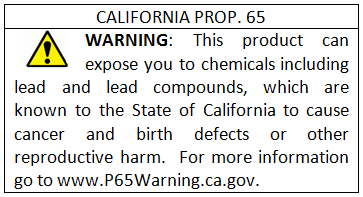
Here is a warning label that manufacturers affix to their consumer products under California Proposition 65. It mentions dangers of chemicals in the article, shows the yellow warning triangle, and provides a link to California’s Office of Environmental Health Hazard Assessment (OEHHA) website.
The EU and UK implemented comparative energy efficiency ecolabels to make it easy for consumers to learn how a device’s performance ranks compared to others.
The scale ranges from G to A, with G in red being the least efficient and A in green being the most performant.
Here in bold is the energy consumption in either kWh per year, 1000 hours, or 100 cycles, depending on the product type.
Here is a QR code that links to further information about the product, online.
These icons indicate noise levels, water consumption, storage capacity and more.

Here is the Canadian Energuide label. It is mandatory for some appliances and voluntary for others. It displays four pieces of information:

Likewise, the United States also has an energy guide label. It displays the appliance’s:


Have you noticed this symbol on your laptop or phone charger?
As per the International Efficiency Marking Protocol, External Power Supply Units require a given minimum energy efficiency.
The Latin number indicates the device’s performance. The higher the number, the more efficient the product.
Thank you for listening. Next time you see these symbols on an electrical or electronic device, you might have a better idea of what they mean.
To conclude, here is a picture of my laptop charger. How many product environmental ecolabels do you recognize? What do they mean?
Visit www.getenviropass.com for a free environmental compliance consultation.