
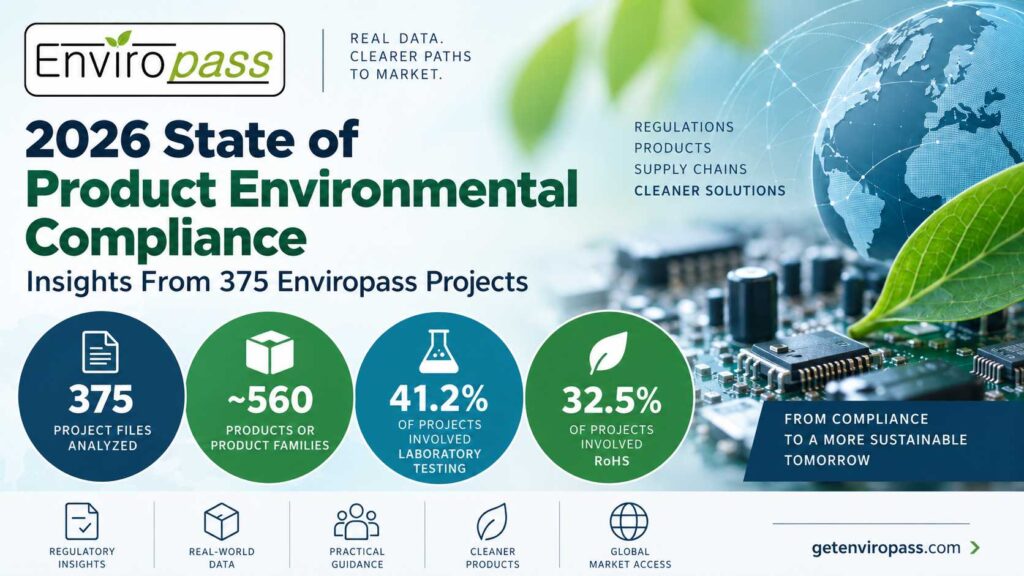
Based on 375 Enviropass project files covering approximately 560 products or product families, this 2026 product environmental compliance analysis examines the regulations, documentation gaps, materials, testing needs, costs, and project delays most frequently encountered by electronics manufacturers.
Product environmental compliance is no longer a final checkpoint before product launch. It has become a continuous business process connecting product design, purchasing, supplier management, laboratory testing, technical documentation, packaging and market-access decisions.
For electronics manufacturers, the question is no longer simply whether a product is “RoHS compliant.” Companies increasingly need to demonstrate that the product, its components, its materials and, in many cases, its packaging meet the environmental requirements applicable in each target market.
At Enviropass, our 2026 project portfolio illustrates this expansion clearly. Established requirements such as RoHS compliance, REACH SVHC and California Proposition 65 remain central, while PFAS requirements, packaging rules, persistent pollutants, material reporting and supply-chain data obligations are creating new compliance challenges.
So what are manufacturers actually dealing with most often?
To answer that question, we reviewed our own 2026 project portfolio.
In this article
The following results are based on environmental product compliance projects performed or managed by Enviropass between January 1 and August 31, 2026.
Indicator | Enviropass 2026 data |
|---|---|
Enviropass project files analyzed | 375 |
Products or product families represented | Approximately 560 |
Manufacturers/clients represented | 280 |
Distinct country/major regulatory markets | 13 |
Geographic markets/jurisdictions represented | 20 |
Projects involving RoHS | 32.5% |
Projects involving REACH | 26.7% |
Projects involving California Proposition 65 | 8.8% |
Projects involving packaging/EPR requirements | 6.9% |
Projects involving PFAS requirements | 6.4% |
Projects involving laboratory testing | 41.2% |
Projects primarily involving documentary/supplier review | 33.4% |
Consulting/advisory | 15.5% |
Training | 4.3% |
Audits | 2.1% |
Other less frequently represented project types | 3.5% |
Source: Enviropass Expertise Inc., 2026 Product Compliance Project Portfolio, January–August 2026.
For this analysis, a project is defined as one client mandate, regardless of the number of products or regulations included within that mandate.
One project may address several regulatory requirements. Consequently, percentages by regulation may total more than 100%.
The remaining 3.5% of projects consisted of less frequently represented activities and specialized requirements, including Conflict Minerals and Responsible Sourcing, WEEE/E-Waste, material declarations and compliance data, regulatory monitoring, battery compliance, ecodesign and other product environmental requirements.
This analysis is not intended to represent the entire electronics industry. It provides a snapshot of issues encountered through actual Enviropass work for manufacturers selling into the European Union, United Kingdom, United Arab Emirates, United States, Canada, China, Japan, India, Norway, Saudi Arabia, South Africa, Australia and New Zealand.
Based on the Enviropass 2026 portfolio, RoHS, REACH and California Proposition 65 are the three regulatory frameworks encountered most frequently.
Regulatory requirement | Share of Enviropass projects |
|---|---|
RoHS | 32.5% |
REACH SVHC / Annex XVII | 26.7% |
California Proposition 65 | 8.8% |
Packaging / PPWR / EPR | 6.9% |
PFAS | 6.4% |
POPs | 5.6% |
TSCA / TSCA-PBT | 4.3% |
Other product environmental requirements | 8.8% |
Source: Enviropass Expertise Inc., 2026 Product Compliance Project Portfolio, January–August 2026.
These requirements appeared across products including medical equipment, industrial controls, power supplies, cable assemblies, connected devices and robotic equipment.
RoHS requirements remain a common starting point because RoHS-style restrictions apply to electrical and electronic equipment in numerous markets worldwide.
In the European Union, RoHS currently restricts ten substances, including lead, cadmium, mercury, hexavalent chromium, two groups of brominated flame retardants and four phthalates.
In Enviropass assessments, lead is the RoHS substance most frequently encountered as a potential compliance risk, particularly in solder, metal alloys and hardware.
Importantly, identifying a restricted substance does not automatically establish that a product is non-compliant. RoHS concentrations are generally evaluated at the homogeneous-material level, and specific applications may benefit from an applicable exemption.
Effective RoHS compliance is therefore an evidence-management and material-risk process, not simply a supplier checkbox.
REACH compliance remains equally important because the Candidate List of substances of very high concern (SVHCs), restrictions and associated obligations continue to evolve.
A declaration that was adequate when a product was launched may become outdated when:
Among the REACH projects included in the Enviropass 2026 dataset, approximately 30% required additional supplier follow-up because the available declaration was incomplete, outdated or insufficiently specific.
This is an important reason not to treat REACH compliance as a one-time exercise.
REACH also cannot be reduced to a generic “REACH compliant” statement. Candidate List obligations, Article 33 communication, SCIP requirements and Annex XVII restrictions address different regulatory questions.
A defensible REACH assessment therefore needs to evaluate the product structure, applicable substances and restrictions, supplier evidence, available test information and the company’s obligations within the supply chain.
California Proposition 65 continues to appear frequently in product compliance assessments for companies selling into California.
Unlike RoHS, Proposition 65 generally focuses on exposure to listed chemicals rather than establishing one universal concentration limit for every finished product.
An assessment may therefore require a combination of:
In Enviropass’s 2026 portfolio, substances and materials commonly requiring additional Proposition 65 investigation included Bisphenol A (BPA), cadmium and cadmium compounds, carbon black, DEHP, hexavalent chromium compounds, lead and lead compounds, and nickel.
PFAS represented 6.4% of Enviropass projects analyzed between January and August 2026.
Enviropass PFAS-related project activity increased by approximately 62% when comparing January 2023 to December 2024 with January 2025 to August 2026.
This is one of the clearest changes observed in our recent product environmental compliance work.
Electronics may contain fluorinated substances in:
The challenge is that PFAS describes a very large family of substances, while jurisdictions may use different definitions, reporting requirements, exemptions, thresholds and effective dates.
As a result, a generic question such as “Is this product PFAS-free?” can be misleading unless the applicable regulation and PFAS definition are first established.
Our PFAS compliance work for electronics most often involves laboratory testing or product/BOM assessments, frequently alongside RoHS, REACH, Proposition 65, TSCA-PBT and POPs. A smaller but growing portion involves PFAS reporting, declarations and North American regulatory requirements.
Common documentation gaps include:
A practical PFAS compliance strategy may therefore combine regulatory interpretation, supplier outreach, material screening, historical information, full material disclosures and targeted analytical testing.
For companies potentially subject to U.S. TSCA PFAS reporting, particular attention should be paid to EPA’s current Section 8(a)(7) rule, its scope, exemptions and applicable reporting timetable.
Packaging component | Information that may be needed |
|---|---|
Boxes and cartons | Material, weight, composition, recyclability |
Plastic films and bags | Polymer/resin, weight, additives |
Trays and inserts | Material, weight, recycled content where relevant |
Foams | Polymer type, weight, composition |
Labels | Substrate, adhesive and weight |
Pallets and transport packaging | Material and quantity |
Closures, straps and protective materials | Composition and weight |
Among Enviropass projects involving PPWR, an estimate of 90 % initially lacked sufficient packaging information to complete the assessment.
Among projects involving Canada’s Federal Plastics Registry (FPR), approximately 50% required additional packaging or supplier research because sufficient resin or weight data was not initially available.
This is why Enviropass increasingly recommends incorporating packaging into the product compliance BOM rather than collecting this information only when a reporting deadline approaches.
Approximately 41.2% of the projects analyzed involved analytical testing of physical samples, while 33.4% were primarily based on documentary assessment, supplier evidence and supply-chain investigation.
Assessment approach | Share of projects |
|---|---|
Laboratory testing involved | 41.2% |
Primarily documentary/supplier assessment | 33.4% |
Source: Enviropass Expertise Inc., 2026 Product Compliance Project Portfolio, January–August 2026.
Neither method is appropriate for every product.
Documentary review is generally the most efficient starting point for a complex electronic product.
The process may include:
A good documentary review can prevent unnecessary laboratory testing.
Among Enviropass’s standard documentary product assessments conducted between January and August 2026, approximately 20% could be adequately supported without additional laboratory testing because sufficient supplier or material documentation was available.
Approximately 80% required further investigation, such as additional supplier documentation, technical clarification or targeted analytical testing, because the initial evidence was incomplete or inadequate.
For manufacturers that want to identify these weaknesses before beginning a full assessment, an environmental product gap analysis can help identify missing evidence and regulatory risks before they delay the project.
Laboratory testing becomes particularly useful when supplier documentation is:
Depending on the material and substance involved, testing may include XRF screening, GC-MS and other targeted analytical methods.
Among Enviropass projects requiring laboratory work, the materials most frequently tested included ABS, polycarbonate, polypropylene, PVC, synthetic rubber and metal alloys.
The substance groups most frequently investigated included lead compounds, cadmium compounds, DEHP, PBDEs, BPA, SCCPs and PFAS.
Testing, however, is not a substitute for understanding the product.
A laboratory result answers a defined question based on a particular sample, analyte list, detection limit and test method. The strongest compliance strategies therefore combine supplier evidence, material-risk assessment and focused testing instead of analyzing every part for every possible substance.
Learn more about Enviropass chemical and product compliance testing.
Environmental compliance risk is not distributed equally throughout a product.
Based on recurring observations in Enviropass projects, the material categories most frequently requiring additional investigation in 2026 were:
Rank | Material or component | Main compliance concern |
|---|---|---|
1 | PVC | Lead, DEHP / RoHS and Proposition 65 |
2 | Metal alloys | Lead, cadmium / RoHS and REACH |
3 | Solder | Lead / RoHS |
4 | Synthetic rubber | PAHs, SCCPs / REACH Annex XVII and POPs |
Ranking basis: Qualitative practitioner assessment based on recurring observations in Enviropass projects; this is not a statistical frequency ranking.
Source: Enviropass Expertise Inc., 2026 Product Compliance Project Portfolio, January–August 2026.
Lead remains an important RoHS consideration because it can occur in solders, metal alloys, glass, ceramics, pigments, stabilizers, coatings and specialized components.
In some applications, its presence may be permitted under an applicable exemption, but the concentration, homogeneous material and exemption conditions must be properly documented.
PFAS present a different challenge. Fluorinated materials may be intentionally selected for heat resistance, chemical resistance, low friction, dielectric performance, or water and oil repellency.
Relevant applications can include fluoropolymers, cable insulation, seals, gaskets, coatings and manufacturing aids.
Soft plastics and synthetic rubbers can also warrant increased scrutiny because cables, flexible PVC, boots, grips, seals and grommets may contain plasticizers, flame retardants, stabilizers, pigments and other additives relevant to RoHS, REACH, Proposition 65, Persistent Organic Pollutants (POPs) or TSCA restrictions.
The practical lesson is simple:
Risk-based assessment is more effective than treating every component equally.
One of the clearest findings from Enviropass’s 2026 work is that significant compliance problems often begin with missing product data rather than laboratory failures.
The most frequent information gaps observed in BOM reviews were:
Rank | Documentation or data gap | Estimated frequency |
|---|---|---|
1 | Incomplete BOM – missing parts/materials such as solder | 50% |
2 | Incomplete BOM – missing alternative sources | 50% |
3 | Missing supplier/manufacturer statements | 20% |
4 | Incomplete or outdated supplier/manufacturer statements | 10% |
Frequency denominator: BOM reviews. A project may contain more than one documentation gap.
Source: Enviropass Expertise Inc., 2026 Product Compliance Project Portfolio, January–August 2026.
A common example is an incomplete flat BOM.
Teams may omit solder, coatings, lubricants, adhesives, labels, inks, packaging, spare parts, accessories or consumables because these are not always managed as conventional purchased components.
Unknown manufacturers and internal part numbers without supplier cross-references create another problem: even when a declaration exists, it may be difficult to establish that it actually covers the material used in production.
Supplier declarations also vary significantly in quality.
A statement saying only “RoHS compliant” may fail to identify:
Test reports can present similar limitations. They may apply to a different resin, a product family rather than the exact component, a limited list of substances or an earlier formulation.
The best compliance evidence is not simply the document that exists.
It is the document that demonstrably applies to the product being assessed.
For complex supply chains, collecting a Full Material Disclosure (FMD) can provide a more reusable material-data foundation for RoHS, REACH, PFAS, POPs, and other requirements.
Need help evaluating your supplier evidence? Explore our RoHS and REACH product assessment service.
Based on Enviropass project experience, a typical environmental product compliance assessment takes approximately four weeks once the necessary product information, documentation and samples are available.
Type of project | Typical Enviropass timeframe |
|---|---|
Straightforward laboratory testing | 1–3 weeks |
Standard product compliance assessment | 4 weeks |
Complex supplier/documentary assessment | 4–6 weeks |
Large or particularly complex BOM | 4–5 weeks |
Source: Enviropass Expertise Inc., 2026 Product Compliance Project Portfolio, January–August 2026.
For approximately 75% of delayed projects, the principal cause of delay was an incomplete BOM and/or missing samples.
Other causes included changes to project scope and administrative holds.
This distinction matters because the technical review itself may not be the longest part of a project. Supplier follow-up, missing product information and corrective actions can become the critical path.
Importantly, once the required BOM information was complete and/or the necessary samples were received, Enviropass processed the project without additional internal delay or queuing.
Cost depends primarily on:
Based on Enviropass’s 2026 projects:
Indicator | Enviropass experience |
|---|---|
Starting cost – simple heavy-metals XRF test | $120 |
Median project cost | $1,600 |
Average project cost | $4,045 |
Source: Enviropass Expertise Inc., 2026 Product Compliance Project Portfolio, January–August 2026.
These figures are indicative rather than universal.
The $120 starting price refers to a single-material test, while multi-regulation assessments of complex electronic systems may require substantially more investigation.
The difference between the $1,600 median and $4,045 average reflects a smaller number of larger multi-product and multi-regulation projects that increase the average.
The most reliable way to control cost is to begin with a complete BOM and usable supplier evidence so that laboratory testing and supplier follow-up can be directed toward the areas that actually present risk.
A risk-based compliance workflow can be organized into eight stages:
Stage | What to do |
|---|---|
1. Define markets and obligations | Identify countries, product categories, business roles, customer specifications and deadlines. |
2. Build the complete product and packaging BOM | Include components, materials, finishes, accessories, consumables and packaging. |
3. Collect supplier evidence | Obtain declarations, full material disclosures, test reports, safety data and exemption information. |
4. Validate the evidence | Check part numbers, dates, regulatory references, thresholds, signatures and applicability. |
5. Rank material and supplier risks | Prioritize substances, materials and suppliers most likely to create compliance gap |
6. Test selectively | Use analytical testing to answer defined questions where documentary evidence is insufficient. |
7. Document conclusions | Maintain results, assumptions, exemptions, supporting evidence and corrective actions. |
8. Monitor regulatory and product changes | Reassess when laws, suppliers, materials, designs or target markets change. |
This approach avoids spending the same level of effort on every component while creating a defensible record of why evidence was accepted, why particular materials were tested and how outstanding risks were managed.
For companies placing applicable products and packaging on the Canadian market, the Federal Plastics Registry adds another reason to maintain reliable material and packaging data.
Current federal requirements continue Phase 1 reporting for applicable plastic categories for the 2024, 2025 and 2026 calendar years, while reporting for Phases 2 and 3 has been postponed.
For affected organizations, this creates a need to identify plastic quantities, applicable product categories, resin information and supporting records.
Among Enviropass projects involving Canadian plastics reporting, approximately 50% required additional supplier or packaging research because sufficient resin or weight data was not initially available.
This illustrates a broader trend:
Material data collected for one regulation increasingly supports several compliance obligations.
A detailed material declaration may help address not only RoHS and REACH, but also PFAS, POPs, packaging, plastics reporting and emerging digital product-information requirements.
The direction of product environmental compliance is increasingly clear.
Manufacturers are being asked for more granular information about:
For Enviropass clients, we expect PPWR, PFAS and international RoHS requirements—particularly requirements in major emerging markets—to generate significant compliance activity over the coming year.
For electronics manufacturers, preparing early increasingly means treating product environmental compliance as part of the product-data architecture, rather than as a collection of certificates requested shortly before shipment.
Based on our 2026 project portfolio:
Finding | Enviropass observation |
|---|---|
Most frequently assessed regulation | RoHS — 32.5% of projects |
Fastest-growing compliance topic | PFAS — approximately +62% between Jan 2023 - Dec 2024 and Jan 2025 - August 2026 |
Most common restricted-substance/material ris | Lead — particularly in solder and metal alloys. |
Most common documentation deficiency | Incomplete BOMs — missing parts/materials and alternative sources, both estimated at 50% of BOM reviews |
Share of projects involving analytical testing | 41.2% |
Share primarily involving documentary/supplier assessment | 33.4% |
Most common cause of project delay | Incomplete BOMs and/or missing samples — approximately 75% of delayed projects |
Emerging issues to watch for 2027 | PPWR, PFAS and international RoHS requirements |
Source: Enviropass Expertise Inc., 2026 Product Compliance Project Portfolio, January–August 2026.
These findings reinforce one central conclusion:
Testing remains essential where evidence gaps exist, but testing everything is rarely the most efficient solution.
Likewise, collecting supplier declarations without evaluating their scope, age and technical adequacy can create a false sense of security.
The strongest compliance programs combine regulatory intelligence, supplier management, full material information, risk assessment, targeted analytical testing and controlled technical documentation.
Since 2020, Enviropass has handled approximately 1,160 product environmental compliance projects, ranging from single-material laboratory analyses to multi-regulation assessments covering complex electronic product families and international markets.
Our work combines documentary assessment, supplier investigation and physical sample testing so manufacturers can select an evidence strategy appropriate to their product, markets, timeline and budget.
The objective is not simply to collect more compliance documents.
It is to identify the evidence that matters, find the gaps that create risk and build a compliance file capable of supporting reliable market access.
Get a clear, risk-based plan for your product.
Enviropass can review your target markets, product structure, available supplier evidence and testing needs to determine the most appropriate compliance strategy.
Written and technically reviewed by: Aurélien “Aury” Hathout, M.Env., VEA®, CEA
Last technical review: September 2026
This analysis was reviewed for technical accuracy and consistency with Enviropass project records and the regulatory frameworks referenced throughout the article.
This article is based primarily on Enviropass Expertise Inc.’s 2026 product environmental compliance project portfolio.
The analysis covers 375 project files reviewed between January 1 and August 31, 2026, representing approximately 560 products or product families and 280 manufacturers or clients.
Project classifications were based on the principal regulatory, documentary, testing, consulting, training and audit activities recorded in Enviropass project files. Because some projects involved multiple regulations, services or identified gaps, certain categories are not mutually exclusive and percentages may overlap.
Findings relating to supplier documentation, BOM completeness, laboratory testing, project timing and project costs were derived from Enviropass internal project records and are intended to describe observed project patterns rather than provide industry-wide statistical estimates.
Regulatory statements referenced in the article are based on primary and authoritative sources, including relevant legislation, regulatory agencies and standards organizations.
Source: Enviropass Expertise Inc., 2026 Product Compliance Project Portfolio, January–August 2026.
This page is based primarily on authoritative regulatory sources, including:
Where statistics or observations are identified as Enviropass data, they are derived from Enviropass Expertise Inc.’s own product compliance project experience according to the methodology described above.